
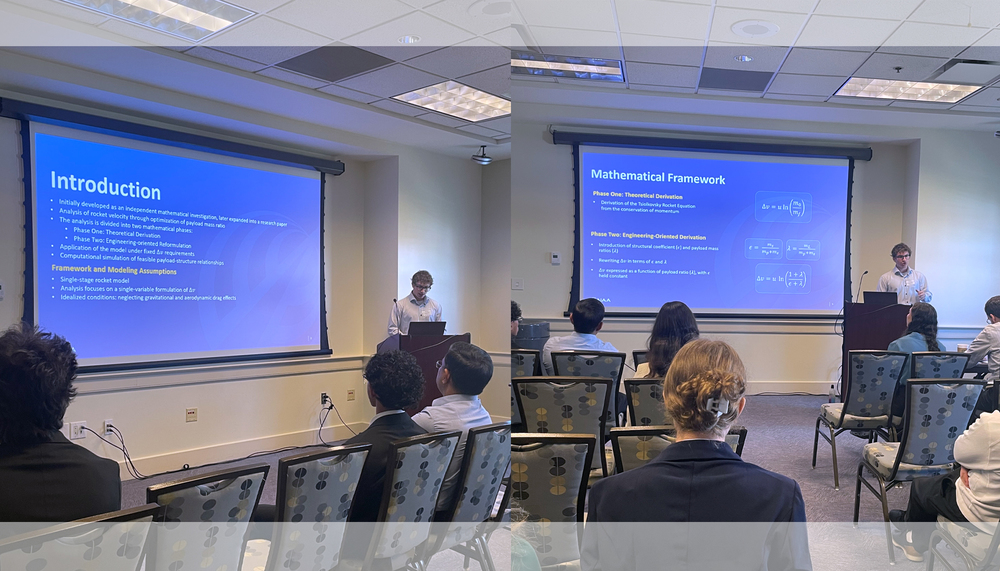
Hauppauge High School senior Tanner Klass recently had the opportunity to present his original aerospace research at the American Institute of Aeronautics and Astronautics (AIAA) Student Conference, held at the University of Maryland, College Park. Originally created as part of his IB Math HL coursework, Tanner’s paper grew into a much larger academic and personal achievement.
Tanner’s research focused on how rockets can travel faster and more efficiently by carefully balancing fuel, structure, and payload weight. His paper explored the Tsiolkovsky Rocket Equation, a mathematical formula used in aerospace engineering to calculate how a rocket changes speed as it burns fuel.
To complete the project, Tanner divided his work into two major sections. In the first phase, he studied the science and math behind rocket motion, using principles such as conservation of momentum and calculus to explain how rockets lose mass as fuel is burned during flight.
In the second phase, Tanner adapted the equation to better reflect real-world rocket systems by introducing engineering variables such as structural efficiency and payload mass. He then used Python programming to run simulations and analyze how these factors affected a rocket’s performance during a modeled mission.
The mission he based his research on was inspired by NASA’s Mars Sample Return program. His simulation examined a launch vehicle traveling from the surface of Mars into low orbit, requiring a velocity change of approximately 4,000 meters per second—nearly 9,000 miles per hour. Through his calculations, Tanner determined an optimized payload ratio that would allow the mission to successfully meet its target velocity.
His interest in propulsion and aerospace engineering first developed while attending an aerospace engineering summer program at UCLA. When searching for a challenging yet manageable topic for his IB Math Internal Assessment, he discovered the Tsiolkovsky Rocket Equation and quickly became interested in the balance of physics, algebra, and calculus involved in the concept.
Tanner described the conference as an incredibly rewarding experience that extended far beyond the presentation itself. Throughout the event, he connected with fellow students from across the country, spoke with a representative from Lockheed Martin, and gained valuable insight into the future of the aerospace industry.
He was especially inspired by the range of projects presented by other students, which included topics such as lunar elevators, detecting space debris using smartphones, turbofan engine design, and drone cybersecurity. Tanner also attended a keynote presentation by Dr. Van Wie of the Johns Hopkins University Applied Physics Laboratory, whose comments about the current “golden age of aerospace” left a lasting impression and gave him an even greater sense of excitement about pursuing a future in the field.
Although Tanner admitted he was nervous while preparing for the conference, he said he felt surprisingly calm and focused during both his presentation and the question-and-answer session that followed. Audience members later approached him to compliment his work, and one student leader encouraged him to become involved in the International Rocket Engineering Competition (IREC).
Reflecting on the experience, Tanner said the conference reinforced the importance of curiosity, persistence, and continually challenging himself academically. The opportunity motivated him to keep exploring new ideas and pursue future research in aerospace engineering.
Congratulations to Tanner on this outstanding accomplishment and for representing Hauppauge High School on a national academic stage.