Over the next several weeks, we’ll be highlighting students from Hauppauge High School’s IB program who have completed their Internal Assessments (IA). These projects give students the opportunity to explore their passions and design their own learning experiences—showcasing creativity, critical thinking, and real-world connections.
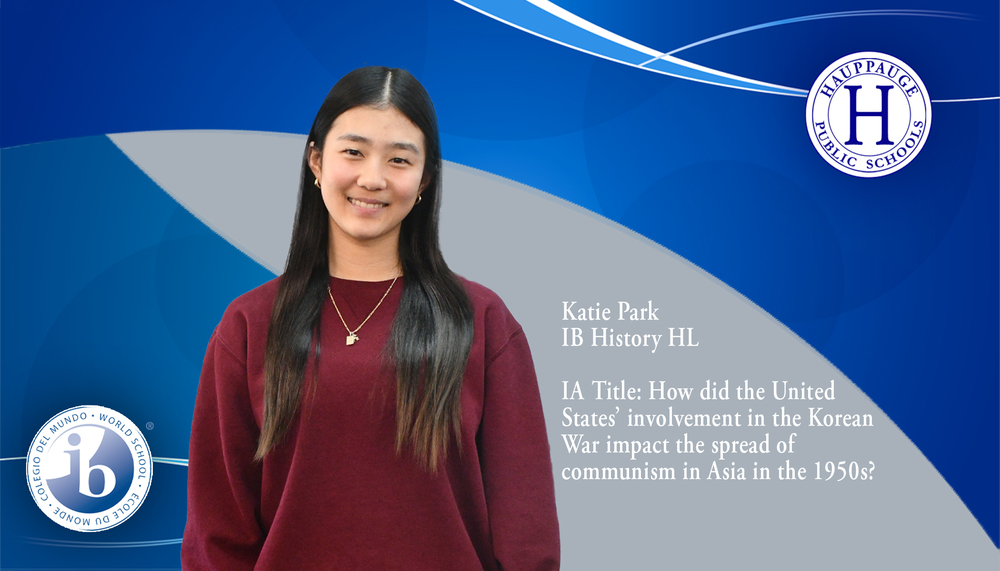
Next up, junior Katie Park and her IB History HL project, “How did the United States’ involvement in the Korean War impact the spread of communism in Asia in the 1950s?”
Katie Park’s investigation explored how U.S. involvement in the Korean War influenced the spread of communism across Asia during the 1950s. Focusing on the broader context of the Cold War, she examined how American military, political, and economic actions shaped regional dynamics during this pivotal period. By analyzing political outcomes, military consequences, and ideological shifts, Katie evaluated the extent to which U.S. intervention contained communism or intensified tensions between communist and anti-communist forces. Her research highlighted the complexity of the conflict, demonstrating that while U.S. involvement limited communist expansion in some areas, it also deepened divisions and contributed to future conflicts across the region.
Why Katie chose this topic:
I chose this topic because of my cultural background. It encouraged my interest in Korean history along with U.S. involvement. My family comes from Korea and so I started to wonder how the United States connected to Korea. The Korean War was a turning point in the Cold War, not only for Korea, but also for the United States. I decided to investigate how and why this is and came to realize the significance of the U.S. involvement in the Korean War and how this impacted the spread of communism in Asia.
What Katie found interesting about the project:
What made this topic interesting was discovering that the Korean War wasn’t just a regional conflict, but a turning point that reshaped Cold War dynamics across all of Asia. Before researching this topic, I assumed the U.S. involvement simply stopped communist expansion. However, I found out that while American intervention prevented South Korea from becoming communist, it also intensified conflicts between the Soviet Union and the U.S. which deepened their ideological divisions across the region and increased conflicts. It was especially interesting to learn how the Korean War influenced future U.S. policies beyond Korea. Truman’s policy of containment contributed to the increased American militarization in other nations, specifically Vietnam. This showed me how the impact of the war was far beyond just Korea and had impacted the Asian region. What I found most exciting was realizing that historical events aren’t just a simple, clear answer: it isn’t a simple outcome of communism in that specific nation. The U.S. involvement both limited communist expansion and intensified the Cold War polarization. This complexity made the investigation more interesting because it challenged my original assumption and required me to evaluate multiple perspectives rather than settling on a simple conclusion.
What Katie learned from the IA experience:
I felt that the process helped me grow and improve on my writing skills and my ability to research efficiently. Writing an IA is a lot of work and becomes time consuming. This really made me focus on time management and helped me realize how I have to space out my work and take it step by step. By writing this IA part by part it became less overwhelming and allowed me to have time to think critically and research about my topic. It taught me how to write short and concisely while maintaining the same purpose. Overall, it helped me grow as a writer and researcher while investigating this topic.