
Over the next several weeks, we’ll be highlighting students from Hauppauge High School’s IB program who have completed their Internal Assessments (IA). These projects give students the opportunity to explore their passions and design their own learning experiences—showcasing creativity, critical thinking, and real-world connections.
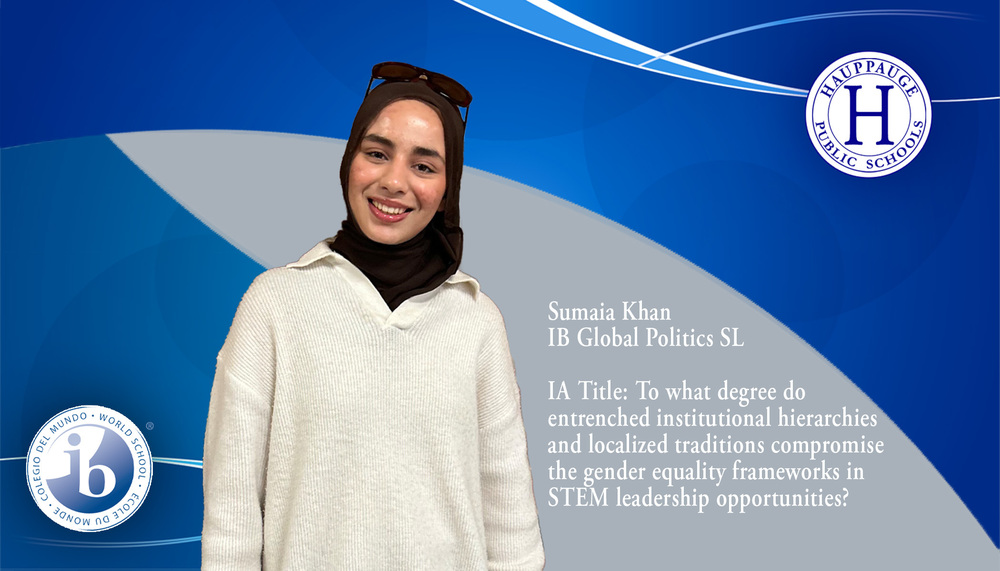
First up, senior Sumaia Khan and their IB Global Politics SL project, “To what degree do entrenched institutional hierarchies and localized traditions compromise the gender equality frameworks in STEM leadership opportunities?”
Sumaia Khan’s investigation examined how global frameworks promoting gender equality intersect with local community norms to influence women’s access to leadership roles in STEM fields. Through interviews with women in medicine and education, as well as leading a workshop for young girls in the community, Sumaia explored how institutional structures, mentorship, and cultural expectations shape both opportunities and aspirations. Sumaia's research also analyzed the gap between formal equality policies and the continued reality of underrepresentation, focusing on how power operates across global, institutional, and community levels, and why the translation of international gender equality efforts into local practice remains uneven.
Why Sumaia chose this topic:
I chose this topic as I recognized a contradiction between the world's voiced commitments to equality and the reality of persistent underrepresentation of women in STEM. As a young woman pursuing a future in medicine and leadership, I have personally encountered subtle discouragement framed as concern and caution disguised as care. This gave the research a sense of moral urgency; I wanted to move beyond merely measuring gaps and instead investigate how barriers are actively reproduced, negotiated, and sometimes obscured beneath the language of progress. It was important for me to bridge abstract policy with real human experience to see how these dynamics function in the spaces I intend to enter.
What Sumaia found exciting or interesting about the project:
The most interesting aspect of this study to me was discovering that inequality in STEM leadership is often sustained through the systemic reproduction of power across layered contexts rather than through overt exclusion.
It was fascinating to observe the process of "norm negotiation" within the community; for example, during my workshop, I saw how global aspirations for women in STEM are translated through local cultural frameworks to maintain continuity with existing values and gender norms. Additionally, I found it interesting to analyze the "instrumental framing" utilized by global organizations, which often justify equality through "efficiency" or "economic utility". This highlighted a significant conceptual tension regarding whether equality is positioned as a means to an end or as an inherent principle, depicting how the way we frame a global issue can fundamentally shape the institutional priorities and outcomes that follow.
What Sumaia learned from the IA experience:
This process was deeply rewarding as it transformed my understanding of global politics from an abstract system of treaties and declarations into a lived negotiation between discourse, structure, and identity. I moved from viewing inequality as a simple gap to be filled toward understanding it as a complex system that must be fundamentally restructured. This experience reinforced the vital insight that global norms only acquire true legitimacy when they are successfully translated into structural changes and authentic dialogue. Moreover, recognizing that power is often exercised through subtle, normalized patterns has not only made me a more critical student of politics, yet has fundamentally reshaped how I view my own agency as a young woman navigating the complexities of leadership in a world where the most formidable barriers are often the ones left unspoken.